
Sleep apnoea · Sandgate, North Brisbane
Sleep Apnoea Treatment with Oral Appliance Therapy
Obstructive sleep apnoea is a serious condition where the airway repeatedly collapses during sleep. It is diagnosed by a doctor, and for suitable adults it can be managed with a custom oral appliance provided by a dentist trained in sleep-related breathing disorders.
- Works with your GP or sleep physician
- Help coordinating sleep studies
- No referral needed to book
- Master's in Sleep Medicine

Diagnosis comes first
Sleep apnoea is diagnosed from a sleep study reviewed by a doctor. Start with your GP and bring your report.
How diagnosis works →Understanding sleep apnoea
What is obstructive sleep apnoea?
While you are awake, the muscles around your airway keep your throat open. During sleep these muscles relax, and in people with sleep apnoea they relax too much. The airway collapses, most often at the soft palate and base of the tongue, where there is no bone or cartilage to hold it open.
As a result, breathing can stop repeatedly through the night, lowering oxygen levels and disrupting sleep. Sleep breathing disorders are often under-diagnosed, and if untreated they have been linked to an increased risk of motor vehicle accidents, heart attacks and stroke.
01
Loud snoring
Often the first sign others notice.
02
Restless, poor-quality sleep
Waking often or feeling unrefreshed.
03
Daytime sleepiness
Fatigue or falling asleep during the day.
04
Other symptoms
Morning headaches, trouble concentrating, mood changes, night sweats or heartburn.
Working with your doctor
Sleep apnoea needs a medical diagnosis
Obstructive sleep apnoea is diagnosed by a sleep physician, usually from an in-lab sleep study (polysomnography) or a home sleep test. We are happy to help coordinate testing.
Once diagnosed, Dr Bachour assesses whether a custom oral appliance is suitable and works with your GP or sleep physician. For moderate to severe sleep apnoea, CPAP is often recommended first.
CPAP
Continuous positive airway pressure is considered the gold standard. Some people find the machine uncomfortable to live with or travel with.
Oral appliance therapy
A custom device that holds the lower jaw slightly forward during sleep to help keep the airway open.
A personalised approach
Sleep apnoea can have many underlying causes, so treatment is tailored rather than one approach for everyone.
Oral appliances
Is an oral appliance right for you?
A mandibular advancement splint is made specifically for your teeth. It does not suit everyone, and we explain what to expect before you decide.
Who may benefit
Some people with mild to moderate sleep apnoea as advised by their doctor, and some with more severe sleep apnoea when their sleep physician advises it.
Who may not be suitable
People with untreated gum disease, loose teeth, too few healthy teeth, significant jaw joint pain or limited jaw movement, or sleep apnoea not caused by airway obstruction.
Alternatives
CPAP, weight management, reducing alcohol, changing sleep position, treating nasal obstruction and, in selected cases, surgery. Your doctor can help you weigh these up.
What to expect
Your sleep apnoea assessment
There are usually a few appointments, and we explain each step.
Consultation
Dr Bachour reviews your sleep study report, health and symptoms, and examines your teeth, jaw and airway.
Records
Scans and records are taken to design your appliance. 3D CBCT imaging is used when clinically indicated.
Fitting
Your appliance is fitted and checked, and we explain how to wear and care for it.
Ongoing review
Regular review is recommended. Contact us if you notice persistent pain or changes in your bite.
Results vary. An oral appliance does not work for everyone, and some people cannot tolerate it.
Who you will see
Sleep apnoea care with Dr Andrew Bachour
Dr Andrew Bachour is a member of the Australasian Sleep Association and the Australasian Academy of Dental Sleep Medicine, and holds a postgraduate master's degree in Sleep Medicine from the University of Sydney.
Meet Dr Andrew Bachour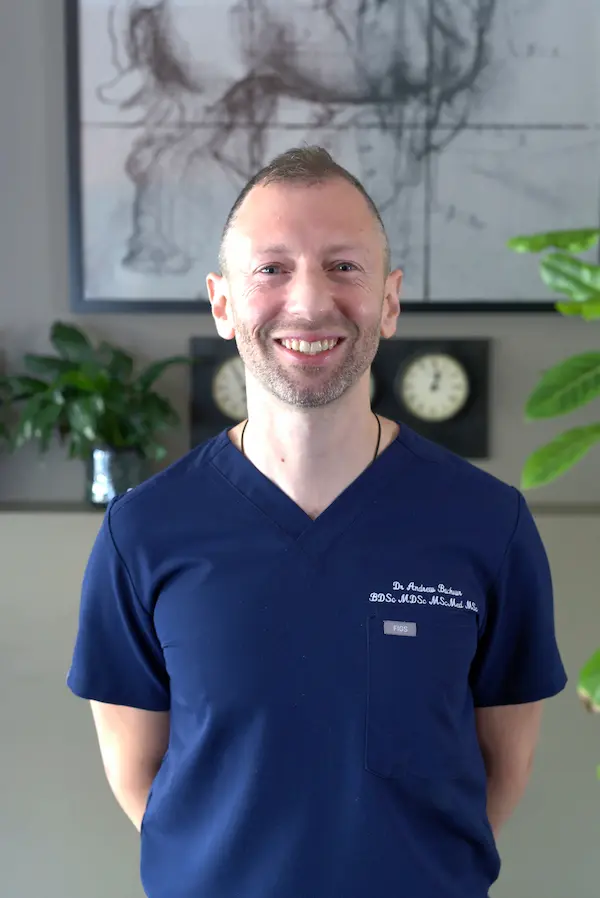
Dr Andrew Bachour
Principal Dentist
BDSc (Hons, UQ). Master's degrees in Sleep Medicine and in Orthodontics & Dentofacial Orthopaedics. General dentist registered with Ahpra (DEN0000972458).
Questions
Sleep apnoea questions
Can a dentist diagnose sleep apnoea?
No. Sleep apnoea is diagnosed by a doctor from a sleep study. A dentist trained in sleep-related breathing disorders can assess whether an oral appliance is suitable once it has been diagnosed.
Do I need a sleep study first?
You can book without one, but it is best to speak with your GP and have a sleep study first. Please bring the report to your appointment, and we are happy to help coordinate testing.
What is the difference between a sleep study in a lab and at home?
Diagnosis is usually made from either an in-lab study (polysomnography) or a home sleep test, both reviewed by a doctor.
I have been prescribed CPAP but find it hard to use. Can you help?
CPAP is often recommended first for moderate to severe sleep apnoea. Your sleep physician and Dr Bachour can discuss whether an oral appliance could replace or complement other treatment.
What are the side effects of an oral appliance?
Common effects include jaw or tooth soreness, extra saliva or a dry mouth. Bite changes and tooth movement can occur over time, so regular review is important.
Do I need a referral?
No. You can book an assessment without a referral by calling (07) 3269 2064.
Diagnosed with sleep apnoea, or struggling with CPAP?
Call our Sandgate clinic to book an assessment, and bring your sleep study report.